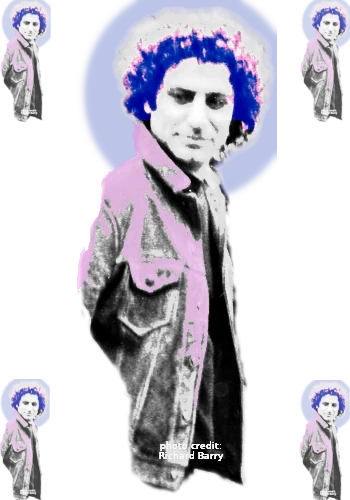
Abbie Hoffman
photo credit:
Richard O. Barry. "Hoffman (center) visiting the University of Oklahoma to protest the Vietnam War," Norman, Oklahoma, c. 1969. [wikimedia commons]Creative Commons: [ CC BY 2.0 ]
hominidmedia:
[Abbie Hoffman #2]other:
Raskin did an interview about Abbie Hoffman (aka Barry Freed) after For the Hell of It was released. Payton describes Hoffman as "a counterculture Pied Piper whose no-holds-barred theatrics helped to entice stoned-out Vietnam-era flower children into antiwar activism" and Raskin as "his longtime comrade and future biographer." Hoffman went underground following the conspiracy trial. He still participated in the countercultural movement. He used aliases, changed his appearance and acted through proxies to avoid the counter-revolutionary police state's charges. According to Payton, "[Hoffman was unable] to cope with the demons of his mental illness..." It seems that his old friends from the underground people kept him alive. The community of radicals that he awakened remembered his efforts when he was in mental distress."Fuck San Francisco
Hoffman, Abbie Steal This Book Chicago, 1971. hosted by [anarchistlibrary.org]
Raskin is a long time ally of Hoffman (aka Barry Freed) who taught Communications at Sonoma State. Hoffaman used guerrilla theater to turn flower children into anti-war activists.
Raskin, Jonah. For the Hell of It: The Life and Times of Abbie Hoffman." Berkeley: University of California Press, 1996.
Payton, Sara. "Jonah Raskin." Sonoma County Independent. California, 1997. hosted by [bohemian.com]
Roberts, Lawrence Mayday 1971: A White House at War, a revolt in the Streets and the untold history of America's biggest mass arrest. Boston: Houghton Mifflin Harcourt, 2020.